
The Hidden Truth About Bra vs Jpn Manufacturing Standards
Here is what nobody tells you about launching a lingerie line inspired by Asian fits.
Most brands get the bra vs jpn manufacturing debate completely wrong. They spend months designing gorgeous packaging, negotiating with influencers, and building a Shopify store. Then they send a standard Western tech pack to a factory and wonder why the final product fits like a restrictive cardboard box. The fit is entirely wrong.
The reality of the market is brutal. Consumers are demanding the ultra-soft, high-support, perfectly molded aesthetics popularized by Japanese lingerie brands. But standard manufacturing specs will ruin that exact silhouette. You cannot just take a standard Western pattern, shrink it down, and call it an Asian fit. The underwire placement is different. The cup depth ratios are different. The tolerance for seam stretch is practically zero.
If your factory does not understand the structural nuances of a jpn style bra, your first production run will be a costly disaster.
How Hello Bra Engineers the Perfect Jpn Style Bra
We do not just nod and accept your tech pack.
As an OEM/ODM lingerie factory based in China since 2003, we have spent two decades reverse-engineering the exact specifications required to manufacture high-end Japanese aesthetics. When you send us a reference sample or a mood board, our pattern makers immediately adjust the apex points, narrow the bridge, and recalculate the spring factor of the elastics. This is how we solve the fit issue before a single piece of fabric is cut.
We operate a 6500 sqm facility staffed by 205 highly trained workers. To hit the exact smooth-cup finish required for modern Asian-fit intimate apparel, we utilize specialized ultrasonic bonding machines alongside traditional single-needle stitching. Our daily output sits at 15,000 pieces, but we never run bulk production until the pre-production sample is flawless.
You get a partner who understands the exact difference between standard western manufacturing and jpn bra engineering. We adjust the pattern. We source the exact 0.5mm high-rebound memory foams. We perfectly calibrate the underwire tension. We sweat the details so your return rates stay near zero.
Practical Specs: Sizing, Materials, and Pricing for Jpn vs Western Bras
If you want to capture the market share of consumers looking for Japanese-style comfort and lift, you have to understand the exact physical differences. Here is what we change in our manufacturing process when we pivot from a standard western bra to a jpn spec build:
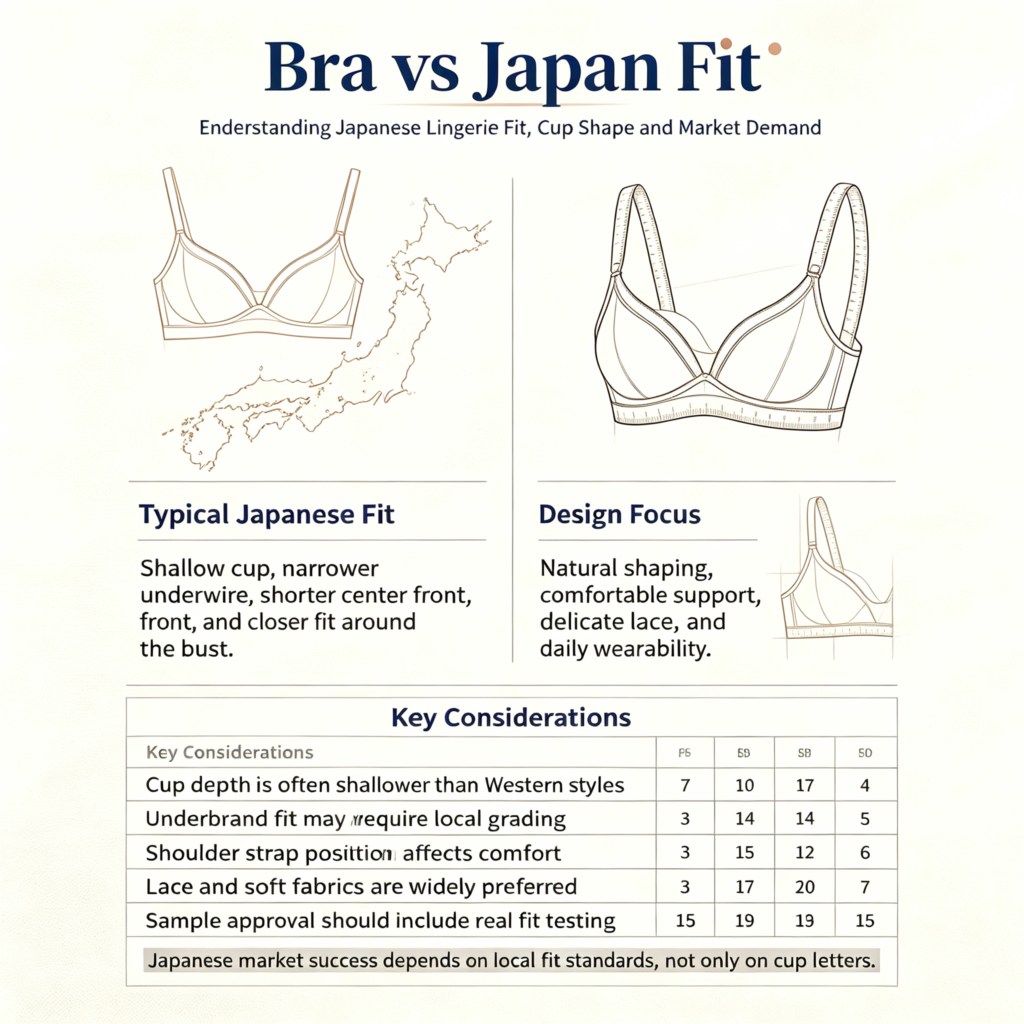
- Cup Volume and Shape: Western cups generally feature a wider horizontal diameter. Japanese cups push the breast tissue upward and inward. We adjust the cross-seam angles by up to 15 degrees to create that specific rounded, front-and-center projection.
- Material Thickness: Standard push-up bras use 2mm to 3mm foam. Jpn styles rely on ultra-thin, highly resilient 0.5mm to 1mm memory foam. We import specialized Korean and Japanese foams to ensure the cup is nearly invisible under thin shirts but still provides structural lift.
- Underwire Geometry: We switch to narrower U-shaped wires with a shorter center gore. This prevents the underwire from digging into the ribcage under the armpits, a common complaint when western women try poorly copied Asian sizing.
- Band Elasticity: The back band requires a much tighter weave with higher elastane content (usually 20-25%) to provide anchor support without relying on thick, bulky straps.
Let us talk about numbers and logistics. Our standard MOQ is 300 pieces per style per color. We understand that testing a new silhouette is risky. We offer a 100-piece trial order for new customers so you can test the market without tying up your cash flow in heavy inventory.
Sample production takes 7 to 15 days. Once you approve the fit and finish, bulk production runs smoothly for 30 to 45 days. We move fast because we know the fashion calendar waits for no one.
Proof: Why Global Brands Trust Our Lingerie Factory
Do not just take our word for it.
Proof is in the production data and the long-term partnerships we maintain. Over the past two decades, we have successfully exported our garments to 20+ countries. We hold OEKO-TEX Standard 100, BSCI, and ISO 9001 certifications. This means our chemical management is strict, our labor ethics are verified by third parties, and our quality control systems meet strict international manufacturing standards.
Look at the experience of one of our Australian clients. They approached us last year wanting to launch a boutique line of seamless, Japanese-inspired uplift bras. They were a startup and terrified of minimum order quantities. We started them out with a 300-piece trial order across three core sizes. Our team helped them source a premium nylon-spandex blend that mimicked the silk-like feel of top-tier Tokyo brands.
The launch was a massive success. Their customers loved the narrow wire and the ultra-lightweight foam. Fast forward exactly eight months, and that same Australian brand is now ordering 10,000 units monthly. They scaled from a risky startup test to a major regional player because the product fit perfectly out of the box.
We know how to build your brand. We know the exact engineering required to bridge the gap between western sizing expectations and eastern aesthetic demands.
Stop settling for factories that only know how to make basic t-shirt bras. If you are ready to develop a premium line that actually fits, we are ready to cut, sew, and ship it.
Contact Hello Bra today to request a tech pack review, book a factory tour, or start your 100-piece trial order. Let us build something exceptional together.