
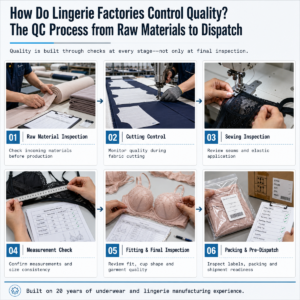
A professional lingerie factory controls quality by checking every stage of production, not just the finished goods. The process usually starts with raw material inspection, then moves through cutting, sewing, measurement checking, fitting review, final garment inspection, packing inspection and pre-dispatch checking.
For lingerie and underwear, this matters more than many other garment categories. Lingerie sits close to the skin. A rough seam, weak elastic, unstable size, poor cup shape or wrong label can quickly turn into customer complaints. That is why a reliable lingerie manufacturer needs a clear quality control process from the moment fabric arrives at the factory until the goods are packed and ready for dispatch.
After 20 years in underwear and lingerie manufacturing, we have learned that quality is not created by one final inspection. It comes from many small checks done at the right time.n
1. Quality Starts Before Production
Good quality control starts before bulk production begins.
Before cutting fabric, the factory should confirm the approved sample, size chart, fabric specification, color standard, trims, logo position, label artwork, packing method and customer inspection requirements. If these details are unclear, the production team has to guess. In lingerie production, guessing usually leads to mistakes.
For private label lingerie orders, this step is especially important. The factory must confirm where the brand label goes, what the wash label says, how the size sticker is used, and how each piece should be packed. A small label or packing error may not look serious in the workshop, but it can create real problems for online sellers, wholesalers and retail buyers.
A responsible lingerie OEM factory will usually hold a pre-production meeting. The sample room, production team, QC team and packing team should all work from the same approved standard.
2. Raw Material Inspection
Raw material inspection is the first real QC step.
When fabric arrives, the QC team checks color, width, weight, hand feel, stretch, recovery, stains, holes, shade difference and visible fabric defects. For lingerie, fabric performance is just as important as appearance. A lace may look beautiful but feel scratchy. A stretch fabric may feel soft but lose recovery after washing.
Trims also need careful checking. These include elastic bands, shoulder straps, hooks and eyes, rings, sliders, lace, bows, underwire, padding, labels and packaging materials. A lingerie product can fail because of one weak hook, one rough elastic edge or one incorrect label.
For higher-standard orders, the factory may also arrange shrinkage tests, washing tests or colorfastness checks. These tests help find problems before the fabric is cut, when correction is still possible.
3. Cutting Quality Control
Cutting has a direct effect on fit and size stability.
Before cutting, the factory checks the marker, fabric direction, fabric layers, color lots and size ratio. Stretch fabric must be placed correctly. If the stretch direction is wrong, the finished lingerie may feel too tight, too loose or uneven when worn.
After cutting, QC workers inspect cut panels before they move to the sewing line. They check whether the pieces match the correct size, whether there are fabric defects, whether different color lots are mixed, and whether the quantity is correct.
For bras, shapewear and bodysuits, cutting accuracy is even more important. Small panel differences can affect cup shape, support, side coverage and overall fit.
4. In-Line Sewing Inspection
A good lingerie factory does not wait until the order is finished to find sewing problems.
During production, in-line QC staff check the sewing line regularly. They look at stitch quality, seam strength, elastic tension, cup shape, strap position, underwire placement, label position and thread trimming.
Common problems include skipped stitches, broken threads, uneven seams, twisted elastic, loose bartacks, wrong label placement and poor edge finishing. If these problems are found early, the line can correct them immediately. If they are found after the whole order is finished, repair takes much longer.
This step is very important for lingerie because many parts are small and detailed. Lace joining, strap attachment, hook-and-eye sewing, cup lining and elastic application all need steady workmanship.
5. Measurement and Fit Checking
Lingerie quality is not only about clean sewing. The product also has to fit.
QC teams measure production pieces and compare them with the approved size chart. Depending on the product, key measurement points may include underband, cup width, wing length, strap length, waist, hip, rise, leg opening or garment length.
Measurement must be done consistently, especially with stretch fabric. Pulling the garment too hard or too lightly can give different results. That is why factories need clear measuring methods and agreed tolerance before production starts.
For new styles, fitting review is also useful. A garment can meet flat measurements but still feel wrong on the body. Experienced lingerie factories pay attention to both measurements and actual wearing comfort.
6. Final Garment Inspection
After sewing and trimming, finished lingerie goes through final garment inspection.
QC staff check appearance, workmanship, measurements, stains, holes, loose threads, fabric defects, color difference, label accuracy and overall finishing. The finished goods should match the approved sample as closely as possible.
This is where many small issues are caught before packing: a loose thread, crooked label, uneven lace edge, wrong size sticker, dirty mark or weak seam. These details may look small, but they affect how customers judge the brand.
For export orders, many buyers use AQL inspection standards. Whether the inspection is done by the factory, the buyer or a third-party inspection company, the goal is the same: confirm that bulk goods meet the agreed quality level before dispatch.
7. Packing Inspection
Packing is part of quality control.
For lingerie brands, packing mistakes can be expensive. The product itself may be correct, but if the barcode, size sticker, color label, polybag or carton mark is wrong, the goods may cause trouble in warehouses, retail stores or Amazon FBA systems.
Before dispatch, the packing team should check polybags, hangtags, size stickers, carton marks, quantity per carton, size ratio and color ratio. Mixed sizes, missing labels and wrong barcodes are common problems when packing control is weak.
A professional lingerie factory should also keep packing photos or records for important orders, so the customer can confirm the goods before shipment.
8. Pre-Dispatch Inspection
Pre-dispatch inspection is the final gate before goods leave the factory.
At this stage, the factory checks packed cartons, total quantity, carton condition, shipping marks and random finished pieces. If the customer has special requirements, such as carton weight, folding method, barcode position or packing ratio, these should be checked again before loading.
Once goods are dispatched, repair becomes slow and expensive. That is why a careful factory would rather spend more time checking before dispatch than deal with avoidable complaints later.
Quality Control Checklist for Lingerie Production
A complete lingerie quality control process usually includes:
- Approved sample and production details confirmation
- Fabric, lace, elastic and trims inspection
- Shrinkage, washing or colorfastness testing when needed
- Cutting panel inspection
- In-line sewing inspection
- Measurement checking
- Fit and comfort review for new styles
- Final garment inspection
- Label, barcode and packing inspection
- Pre-dispatch carton and quantity check
Conclusion
So, how do lingerie factories control quality?
They control it step by step, from raw materials to dispatch. A strong QC process checks fabric before cutting, panels before sewing, workmanship during production, measurements after sewing, packing before carton sealing and final goods before dispatch.
For lingerie brands, stable quality is more important than one good sample. A sample can win the first order, but consistent bulk quality keeps customers coming back.
If you are looking for a lingerie OEM factory or private label underwear manufacturer, do not only ask for price. Ask how the factory controls fabric, trims, sewing, measurements, packing and dispatch. A reliable factory should be able to explain its QC process clearly, because quality is not a slogan. It is daily work on the production floor.
FAQ
How does a lingerie factory check fabric quality?
A lingerie factory checks fabric color, width, weight, stretch, recovery, hand feel, stains, holes, shade difference and visible defects before cutting.
Why is quality control important in lingerie manufacturing?
Lingerie touches the skin directly, so comfort, fit, stitching, elasticity and fabric softness all matter. Small defects can quickly become customer complaints.
What are common lingerie quality problems?
Common problems include unstable sizing, rough seams, loose threads, skipped stitches, weak elastic, poor cup shape, stains, color difference, wrong labels and incorrect packing.
When should lingerie QC start?
Lingerie QC should start before production, when samples, size charts, fabrics, trims, labels and packing standards are confirmed.
What is final inspection in lingerie production?
Final inspection checks finished garments for appearance, measurements, stitching, stains, labels, color, workmanship and packing accuracy before dispatch.
How can brands reduce quality issues?
Brands can reduce quality issues by giving clear tech pack or samples, clear comments on counter samples samples, size charts, fabric requirements, label files, packing instructions and inspection standards before production starts。