
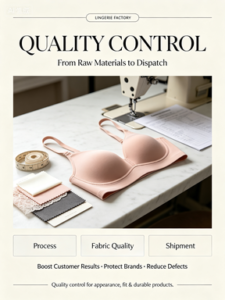
Bra brands highly value quality control since it helps them meet strict market standards for appearance, fit, and durable products. An effective control strategy monitors the process, fabric material quality, and the shipment procedure to boost customer results, protect brands, and reduce defects.
1. The Quality Control Process from Raw Materials to Dispatch
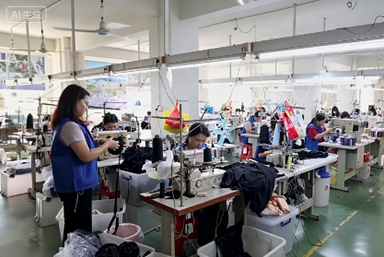
Bras combine complex fabric material through a delicate construction process that makes it critical to install quality control measures. The factory hopes to eliminate all defects in material choice, sizing, and stitching to ensure ultimate support, durability, and comfort.
A strategic quality control system is vital for meeting customers needs, reducing finished products, and minimizing fabric material waste. Most importantly, it is a requirement for meeting international quality standards and ensuring consistent quality in mass production projects.
1.1 Raw Material Inspection
The first critical step in quality control for bra companies is to verify that the materials meet the requirements. Thus, they inspect sliders, hooks, foam cups, and decorative trims. It is vital to check elastics, lace, fabrics, and underwires.
Besides, they must verify the surface defects, softness, weight and color against the approved specs to meet clients’ needs. You can avoid costly wastages by rejecting non compliant and defective fabric material.
1.2 Lingerie Fabric Testing & Performance Evaluation
This step involves testing the fabric for dimensional stability, color, shrinkage, and pilling resistance to ensure durable results. The fabric must pass tests for strength, breathability, and moisture management to retain appearance after daily wear and repeated washing.
In other words, fabric testing is vital to confirm that materials you use suits the production requirements. Thus, it helps to reduce warranty cases and minimize customer complaints.
1.3 Pattern & Sample Verification
Pattern verification is a critical step to confirm approved measurements using product samples before you embark on mass production. You must confirm the construction, strap position, cup shapes, and seam placement.
If the sample product fits with the approved measurements, it confirms that consistency across bulk products will serve a wide customer range. Thus, it provides a platform to make changes and eliminate errors before the mass production process begins.
1.4 In Process Quality Control
Production managers don’t wait for the final garments to test quality. Instead, they test regularly during the process for parts assembly, bonding strength, cutting accuracy, and stitching quality.
During manufacturing, operators conduct their own inspection to detect defects early. Continuous monitoring allows problems to be corrected without affecting large quantities. This way, you can get more efficient production and ensure consistent quality with each order.
1.5 Measurement and Fit Inspection
All styles of lingerie have specific measurements that they must adhere to. The bust width, band length, cup size, strap position, waist size, and other areas are measured using approved size charts.
There are detailed measurement checks on random samples taken from every production batch. Standardised sizing minimises returns and enhances fit satisfaction. A good level of measurement control also gives uniformity from one production lot to another.
1.6 Hardware and Component Inspection
Lingerie comprises numerous components that impact the product’s performance. Hooks, eyes, rings, sliders and underwires are tested for secure attachment, alignment, and durability.
The adjustable components are tested to ensure they move around without compromising the garment. By carefully examining the product, hardware failures that shorten product lifespan can be prevented, thereby increasing customer satisfaction.
1.7 Lingerie Final Product Inspection
Final inspection of the garments is carried out after production, with a high standard of quality expected. Inspections include cleanliness, workmanship, uniformity of colour, labelling, packaging and condition of the fabric and stitching.
Garments with defects are mended or withdrawn from stock prior to packaging. This inspection offers a final chance to assess quality before shipping.
1.8 Packaging and Carton Inspection
Quality control is maintained through the packaging process. Factories check care labels, size labels, barcode, folding, poly bags, retail packaging and carton marking. Inspectors verify that products are packed per customer directions and are safely transported.
Excellent packaging can reduce product damage during shipping, which helps to bring products to the market ready to sell at retail stores. Correct packaging also avoids the loss of money due to inaccurate stock and fulfilment levels.
1.9 Pre-Shipment Inspection and Dispatch
Manufacturers do an end-of-the-line inspection of the completed order before dispatch. Production quantities, packaging, and shipment quality are inspected. Random samples confirm that finished products continue to meet approved standards.
Shipping documents are examined to guarantee product identification and destination. The order can be dispatched only after these last checks. This final inspection provides customers with an assurance that all shipments adhere to quality standards.
2. International Quality Standards Used by Lingerie Factories
A number of professional lingerie manufacturers employ internationally recognized quality management systems to enhance consistency and customer confidence. The factory could adopt the ISO quality procedures, material tracing system and inspection standard throughout the production process.
Frequent staff training sessions, equipment calibration, and process audits further enhance quality performance.To minimize manufacturing risks and promote consistency for products in international markets, brands should collaborate with manufacturers who have recognized quality systems in place.
3. How Technology Improves Quality Control
Digital technologies are increasingly being employed in modern lingerie factories to enhance inspection accuracy and production uniformity. Defects are detected early through Computerised Pattern Systems, Automated Fabric Inspection Devices, Production Tracking Software, and Digital Measurement Tools.
Real-time monitoring allows supervisors to address quality problems promptly. These technologies improve the efficiency, reduce waste, and promote continuous enhancement in the factory.
4. Conclusion
The quality control process is continuous from the receipt of raw materials through to the delivery of the product. Every stage contributes to the lingerie’s comfort, durability, fit, and appearance.
Skilled inspectors, modern technology, and systematic quality control measures can help reduce defects, thus improving customer satisfaction. For lingerie brands aiming to establish long-term success and protect their reputation, it’s important to choose a factory with a sound quality management system.
5. Choose Telige for Reliable Quality Controlled Lingerie Manufacturing
At Telige, we ensure consistent quality for our lingerie products. A very strict quality control team checks raw materials, production processes, and measurements, and finally checks before shipping them out.
Whether OEM/ODM, private label manufacturing, or customised collections, Telige strives to deliver consistent quality and reliable service on all orders.