
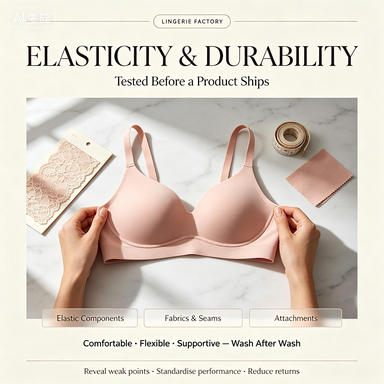
The Best Lingeries stay comfortable, flexible and supportive after being worn and washed many times. Elastic components, fabrics, seams and attachments are tested by manufacturers before products leave the factory to ensure that they will withstand normal wear and tear. These quality controls bring to light any weak points, standardise performance and reduce the chances of customer complaints or product returns. What Is Lingerie Elasticity and Durability? Elasticity of a garment is the ease with which it stretches while being worn and returns to its original shape. It's especially important for waistbands, straps, leg openings, and support components that need to flow freely with the body. The durability of lingerie is its resistance to stretching, washing, and normal wear and tear. Both attributes are checked by the factories by testing the material and examining the finished garments. Stretch, recovery, seam strength, dimensional stability and performance after washing are measured, allowing manufacturers to work out the weak points. This makes sure that lingerie complies with the required quality standards before shipment is approved.1. Define Elasticity and Durability Standards Lingerie factories set standards for elasticity and durability before the production process even starts. These requirements depend on the design of the lingerie and how it is going to be used. The standards can refer to the amount of extension or ability to recover, or even how well the components retain their shape with repeated use. Manufacturers may also set a tolerance for waistbands, straps, leg openings and other elastic areas. The durability may be specified as repeated stretch, washing, and friction resistance, as well as normal wear. Setting measurable standards provides a standard for quality-control teams. It also aids suppliers to know exactly what their materials and finished goods should do as soon as they are shipped. 2. Lingerie Inspect Elastic Materials and Trims Elastic materials, lace, straps, bands and other trims are inspected prior to use in finished lingerie by factories. Contaminations such as visible defect, width variations, surface irregularities, fiber damage, thread loft and color variation are inspected by quality teams. They also might check to see if the elastic is the right thickness, softness, flexibility and construction for the garment.
 1. Define Elasticity and Durability Standards
Lingerie factories set standards for elasticity and durability before the production process even starts. These requirements depend on the design of the lingerie and how it is going to be used. The standards can refer to the amount of extension or ability to recover, or even how well the components retain their shape with repeated use.
Manufacturers may also set a tolerance for waistbands, straps, leg openings and other elastic areas. The durability may be specified as repeated stretch, washing, and friction resistance, as well as normal wear. Setting measurable standards provides a standard for quality-control teams. It also aids suppliers to know exactly what their materials and finished goods should do as soon as they are shipped.
2. Lingerie Inspect Elastic Materials and Trims
Elastic materials, lace, straps, bands and other trims are inspected prior to use in finished lingerie by factories. Contaminations such as visible defect, width variations, surface irregularities, fiber damage, thread loft and color variation are inspected by quality teams. They also might check to see if the elastic is the right thickness, softness, flexibility and construction for the garment.
Measurements made against an approved specification and samples. This first passes allows unsuitable materials to be kept out of the production. It is particularly crucial to identify problems early on as a damaged elastic piece can impact on the garment’s fit, look and comfort as well as its lifespan. Materials which are not up to the required standard do not move on to production.
3. Test Stretch and Recovery
Stretch and recovery testing is used in factories to check if there is recovery and stretch if there is. The sample can be stretched to a certain length or percentage and then it is allowed to return to its original length as the inspectors watch. The test can be repeated under controlled conditions to assess performance overtime.
Various parts of the factory might be evaluated individually such as elastic panels, leg openings, waist bands, and straps. Due to the need for quick recovery, good recovery is essential as lingerie must be secure and comfortable, yet tighten up quickly. Testing can also detect materials that might stretch too much and become permanently altered, preventing factories from having to deal with quality issues when the garments arrive at customers.
4. Conduct Repeated Stretch-Cycle Tests
The performance of the elastic may not be apparent from reliable tests under normal wear conditions. In this regard, factories may conduct repeat testing of stretch-cycle testing, stretching an elastic part and returning it to its original shape, in a controlled manner, several times.
The goal is to produce multiple motions and determine whether the material stretches, stretches permanently or damage is visible. Inspectors check before and after testing for measurements and appearance. Testing can be done on straps, bands, waist or legs depending on the product requirements. Repeated cycle testing can give helpful data with respect to long-term performance, and can be used to determine whether a material is elastic or not, and if so, whether it is suitable for its intended applications.
5. Evalua te Seam and Attachment Strength.
The way elastic components are attached to the garment also must be taken into account in elasticity testing. All strong elastic can break if seams, stitching, or attachment points are not strong. The factories consequently check the seams along the waist, the openings of the legs, elastic to fabric joints, and strap connections. Quality teams can use controlled tension to see if stitching holds up in response.
They search for broken thread, seam opening, tearing in the fabric, or for any stitches that are missing, or for separation of elastic from the garment. This may also cover stitch density, choice of thread, seam making and reinforcing. These tests assure the product can take the normal stretch and action of the wearer without breaking the seams or attachments, when it is finished.
6. Test Lingerie Fabric and Elastic After Washing
Since lingerie is often washed, factories must have an understanding of the behavior of elastic and fabric after washing. Samples can be subjected to controlled washing and drying processes as specified by the product care label and/or applicable test standards. Inspectors check elasticity, recovery, shrinkage, colorfastness, fabric appearance and condition of seams and trims after they have been washed.
They make observations on the change in measurements from before and after washing. Elastic components that may become loose, brittle, twisted or permanently stretched are given a special focus. Washing tests are useful for factories to reveal issues which may not be readily detected with their initial inspection, and give the factory more confidence that the garment will perform after repeated laundering.
7. Check Shape Retention and Dimensional Stability
Lingerie is assessed by factories to see if it keeps its original form and size after stretching, wearing and washing it. Proper measurements can be taken at critical points before testing and compared afterwards for permanent changes. Leg openings, straps, cups and waistbands can be measured for length and width by inspectors. They also check for distortion, twisting, sagging and inconsistent recovery.
The retention of good shape is crucial as lingerie should be supported and fit without changing its intended shape. When there are significant changes in dimensions, factories may want to determine if the problem is with the fabric, elastic, stitching, construction, or finishing. Then corrective action can be done prior to shipment.
8. Perform Final Garment Quality Inspections
After the products have been finished, factories will carry out the final inspection to ensure that the finished lingerie has qualified performance. The overall appearance, stitching, elastic, seams, trims, sizing, measurements and workmanship are inspected. They might examine by hand to see if straps or bands stretch and recover as needed and if the garments maintain their desired shape.
Inspectors further check for loose threads, elastic that has been ripped, stitching that is uneven, stains, holes in fabric or wrong-sized cuts. Inspections can be carried out by sampling or be based on customer requirements and the order and quality-control system used. Final inspection is a final check to ensure the garments are not faulty before they are sold from the factory.
9. Record and Approve Products for Shipment
The last process in the chain is documenting the results of quality control and deciding if it is ready to be shipped. Test results, inspection findings, measurements, defect rates, and corrective actions are recorded where applicable in factories. Quality teams benchmark against Quality Approved Specifications and Customer Requirements.
In the event of large issues, a garment may be repaired, rejected or may be checked again before it is approved. Keeping such records also enables factories to track their suppliers’ and their production performance in the long-term. Goods are approved for packing and shipping by the responsible quality team when the required standards are met. The documented process ensures accountability and uniformity of quality when ordering lingerie in the future.
Conduct Final Garments Quality Checks
The final checks are made at the end of the production line to guarantee that the product is of the desired quality before it is packed and prepared for market. The general appearance, stitching, elastic, seams, trims, sizing, measurements and workmanship are inspected.
They can do this by hand to see that straps and bands stretch and return to their original shape and that garments resume their designed shape. They also look for any issues that are not functioning properly, such as loose threads, ripped elastic, uneven stitching, stains, holes in the fabric, or the size is not the correct one.
Inspection may be by sampling or by the application of customer specified requirements which are part of the order and quality control system. Final inspection is a final check to make sure that any defective pieces of clothing are not sent out from the factory.There was a 90% accuracy rate for documenting and approving products for shipment.
The last step is to record quality-control results and to decide if the production batch is ready to be sent out. Factories document test results, inspection results, measurements, defect rates and corrective actions where applicable. Quality teams validate to standards and customer needs. Garments that present significant issues may be repaired, rejected or re-inspected prior to approval. Keeping these records assists factories to track supplier and production performance over time as well. Goods are approved for packing and shipping once the required standards are achieved, by the quality team responsible for quality. This recorded process makes it accountable and ensures the quality is the same in the next orders of lingerie.