
A Comprehensive Breakdown of the Production Process
The process to launch a lingerie store can be involved since it requires strategic designing and careful plans. In any case, you need the right skills to attain ultimate quality control, concept development, and mass production. This post helps you understand vital phases to manage timelines and set realistic garment expectations.
1. How Long Does It Take to Go from Sampling to Mass Production for Customized Lingerie ?
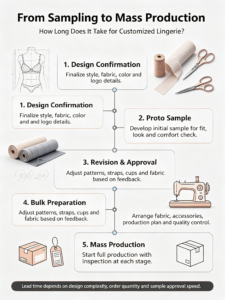
It can take 8 to 16 weeks to launch mass production depending on the capacity, design complexity, and material availability. Customized bra collections demand extra testing and sampling, simple lingerie moves faster.
Yet, manufacturers must maintain clear communication with the brands to speed up production as it allows proper planning. Hence, it enables sufficient attention at each stage to retain high quality standards.
1.1 Product Consultation & Design Planning
The first stage involves discussions to determine the product concept and target market. Other critical issues to discuss include the functional specs, size demands, and color choices.
Besides, the brands and manufacturers test fabric options, reference samples, technical packs, and sketches. This discussion aims to define the right construction options, materials, and production efficiency to reduce waste.
1.2 Material Sourcing & Component Selection
The next stage involves sourcing vital production components such as straps, foam cups, hooks, and decorations. It assembles lace, underwires, fabric, and elastics to facilitate strategic timelines.
It would be better to work with a manufacturer that obtains these components from established supplier networks to ensure quick access. Time is a critical factor for this stage since you need to verify compatibility, fabric performance, and color consistency.
1.3 Pattern Making & Technical Development
The pattern making process involves converting the design into a precise pattern while ensuring accurate fit and support. Therefore, you must monitor the construction details, cup shape, and seam panels to deliver results.
Thus, the team can prepare grading rules, technical specs, and size charts to ensure accurate fitting. This step is a critical foundation of the proceeding stages as it helps avoid fitting issues.
1.4 Prototype Sample Production
The prototype sample features the approved pattern and fabric material to showcase the manufacturer and brand what products to expect. It provides a platform for evaluating the bra fit, appearance, functionality, and make.
Hence, the team can resolve minor issues with parts such as the fabric quality, seam size, cup shape, and the bra strap placement. This stage is possible to achieve at about two weeks before the mass production begins.
1.5 Sample Evaluation & Revisions
Highly customized bra brands may demand multiple evaluations and revisions before approving the final prototype and offering feedback. In any case, this stage can demand changes like decorative details, trims, support, sizing, and fabric quality consideration.
The manufacturer can repeat the prototype sample production process until the brand is satisfied with the revised samples. Overall, this critical stage demands quick communication to minimise development timeframe while ensuring the final product is accurate and meets customers needs.
1.6 Pre Production Sample Approval
This critical step involves producing the exact pre production sample that represents the final lingerie. The vital factor in this stage is to ensure the perfect match for approved specs for labels, packaging, color, and material.
The pre production sample is critical to evaluate the construction method while providing a clear production standard for the manufacturing process. A formal approval from the brand can help avoid conflicts with the factory.
1.7 Mass Production Preparation
The mass production preparation stage involves critical steps such as collecting the raw fabric material, training the production team, checking the sewing machine conditions, and planning the factory mass production schedule.
Planning the production schedule can help organize capacity allocation, organize workflows, and reduce time spending. Meanwhile, the process also reviews the inspection process and final products quality standards to minimize production mistakes and boost effectiveness for large volumes.
1.8 Mass Production
Factors impacting the mass production timeframe include the order quantity, factory workload, and complexity, but it typically takes two to six weeks. This period allows the team to cut, sew, mold, bins, trim, and assemble the materials based on the sample specs.
Thus, it can be critical to hire strict production managers to constantly check and confirm the quality specs during the process. Production managers help to ensure consistent results, appearance, and bra sizing.
1.9 Quality Inspection & Packaging
The factory must conduct a detailed quality check on every finished bra to verify that it meets the overall look, hardware installation, stitching, and measurements standards. In addition, they can conduct random sampling to complete wash testing for durability evaluation before packaging begins.
Inspection approval must be complete for every bale before labeling and packaging in cartons ready for shipping to the customer. Ensuring reliable quality check efforts can improve client satisfaction and reduce product rejects.
2. What Factors Can Delay Production?
International shipping delays, large order volumes, and complex designs are some common factors that worsen the production timeframe. In addition, delayed sample approval, modification requests, and fabric material shortages can drain manufacturing lead times.
Therefore, brands that are proactive in completing technical design info and approving pre production samples can avoid seasonal demand constraints. Most importantly, ensuring smooth communication can be critical to achieve a quick and successful process.
3. How Can Brands Speed Up the Manufacturing Process?
The best way for brands to speed up the production process can be offering detailed technical guides, confirming critical measurements, and choosing raw fabric that is easy to access. In addition, ensuring timely feedback on sample products can boost speed by consolidating design check rounds.
Besides, working with an established bra manufacturing firm can provide access to stable supply chains with structured development procedures. This approach helps deliver excellent results and reduce errors for complex bra designs for quick launches.
4. Conclusion
Lingerie mass production demands coordination with the client to meet performance, comfort, and quality standards. Although the demands vary based on the design complexity, the right company delivers results.
5. Partner with Telige for Efficient Lingerie Manufacturing
Do you need a reliable manufacturer with access to established supply chains and effective manufacturing services? Your search ends here! Telige offers strategic product development and sampling with working quality control specs and design consultants.
The company combines strict quality rules with advanced tech options to meet the customer requirements with exact specs and quick global delivery. Contact Telige today to get specialized guidance in launching new garment stores, expanding product lines, and innovating new lingerie designs.
Plan a Sampling Timeline with the Factory
Actual timing depends on construction, fabric availability, revision rounds and order size. Buyers considering production in Guangdong can review Hello Bra’s Shantou sampling and manufacturing capabilities or request a timeline for a specific bra project.