With 20 years of experience in the lingerie industry, we’ve encountered every type of client—from emerging brand founders and cross-border e-commerce sellers to established wholesalers looking for a stable, long-term manufacturing partner.
The first question most clients ask is: “How much is this style?”
While price is undeniably important, unit cost shouldn’t be the only metric. Lingerie is not a basic T-shirt; a slight deviation in pattern, elasticity, or stitching results in a completely different wearing experience. A sample might look fine, but mass production can often reveal issues like inconsistent sizing, poor elasticity, loose threads, or deformation after washing.
When choosing a lingerie OEM, don’t just look for the lowest bidder—look for the factory that can deliver consistency.
1. Does the Factory Truly Understand Lingerie?
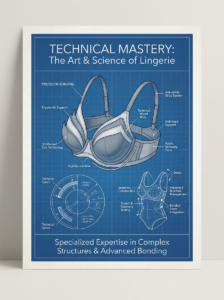
Lingerie is small, but its complexity is immense. Bras, panties, seamless wear, activewear, and shapewear all require vastly different technical expertise.
For instance, producing a bra involves complex structures like cup shapes, straps, underwires, and wings. Seamless wear requires mastery of bonding technology and fabric recovery. Men’s underwear focuses on waistband durability and ergonomic pouch construction.
A factory that merely “can do” lingerie is different from one that “specializes” in it. An experienced partner will advise you during the sampling stage: “Is this fabric elastic enough? Will it sag after washing? Should we adjust the sizing for the US/EU market?” This level of insight comes from decades on the floor, not just looking at a tech pack.
Advice: Find a factory focused on lingerie, rather than one that jumps between T-shirts, swimwear, and bras.
2. Prototyping: Look for “Fit,” Not Just “Looks”
it’s easy to focus on the color, style, or logo placement of a sample. However, the most critical factor is the wearability.
A photo can’t tell you if a garment will pinch, roll up, or lose its shape. Professional factories don’t just ask, “Should we copy this picture?” They confirm the fabric weight (GSM), elasticity, size charts, stitching methods, and packaging requirements. If you only have a reference photo, a reliable factory will provide practical suggestions for mass production rather than blindly duplicating a flawed design.
Note: The more details you confirm during the sampling stage, the smoother the mass production will be.
3. Consistency in Fabric and Trims
The comfort of lingerie depends heavily on the stability of the supply chain. Two fabrics might both be labeled “Modal,” but their hand-feel and durability can vary significantly between suppliers. The same applies to elastics and waistbands—poor quality trims will lose their elasticity after just a few washes.
For brands, the biggest risk isn’t the first order being bad; it’s the quality changing on the second or third order. Inconsistent color batches or fabric tension will destroy your brand’s reputation and repeat purchase rate.
4. Quality Control is in the Details
Many factories claim to have QC, but true quality control happens at every stage. Common issues in private labeling include: size deviations, skipped stitches, broken threads, color shading, and incorrect labeling.
A reliable OEM factory inspects fabric upon arrival, checks for defects during cutting, performs “in-line” inspections during sewing, and conducts a final 100% inspection of the finished product. They don’t wait until the boxes are sealed to find a mistake.
Pro-tip: Before signing, ask about their inspection standards (AQL) and whether they support third-party inspections.
5. Demand Honest Lead Times, Not “Fast” Ones
In a rush to secure an order, some factories will promise unrealistic delivery dates. However, lingerie production is a multi-step process: detail confirmation, material sourcing, sampling, revisions, pre-production approval, cutting, sewing, QC, and packaging. Any bottleneck in sourcing or sampling will delay the final shipment.
A responsible factory provides a realistic timeline, accounting for fabric lead times and current production schedules. For Amazon or wholesale sellers, a stable delivery date is much more valuable than a “fast” one that eventually misses the sales window.
6. Communication is the Best Risk Management
Most production failures stem from poor communication, not poor skill.
- Is the logo printed or woven?
- Is the packaging a single polybag or a set?
- What is the specific size ratio?
- Does the care label meet the regulations of the destination country?
If a factory asks “too many” questions, it’s a good sign. It means they are identifying risks before the needles start moving. Be wary of a factory that says “No problem” to everything without asking for specifics.
7. Negotiate Price, but Avoid the “Race to the Bottom”
We understand the need to control costs, especially for new brands. However, certain costs in lingerie cannot be cut without sacrificing quality. Cheaper fabric leads to skin irritation; cheaper stitching leads to unraveling; and skipping QC leads to high return rates.
A professional OEM will explain the price difference based on materials and craftsmanship rather than simply dropping the price to win the bid. The goal of a healthy partnership is to achieve a stable, high-quality product within your target budget.
Conclusion: Your Factory is Your Strategic Partner
Choosing a lingerie OEM is about more than just finding a production line. Your factory is an extension of your product development, quality assurance, and delivery capability.
Telige has been specializing in lingerie production for 20 years. We support OEM, ODM, and Private Labeling services for clients worldwide. Whether you are launching a new brand or seeking a stable supplier for high-volume orders, we provide expert advice on mass production, fabric selection, and sizing.
Contact us today with your specific styles, quantities, and requirements. Let’s build something stable together.
Evaluate a Bra Manufacturer in Shantou, Guangdong
Hello Bra is operated by Shantou Telige Apparel Co., Ltd. in Shantou, Guangdong. Review our Shantou bra manufacturer capabilities for product scope, typical MOQ, sample timing and private-label support. To evaluate a specific style, send your tech pack, reference image and target quantity.