
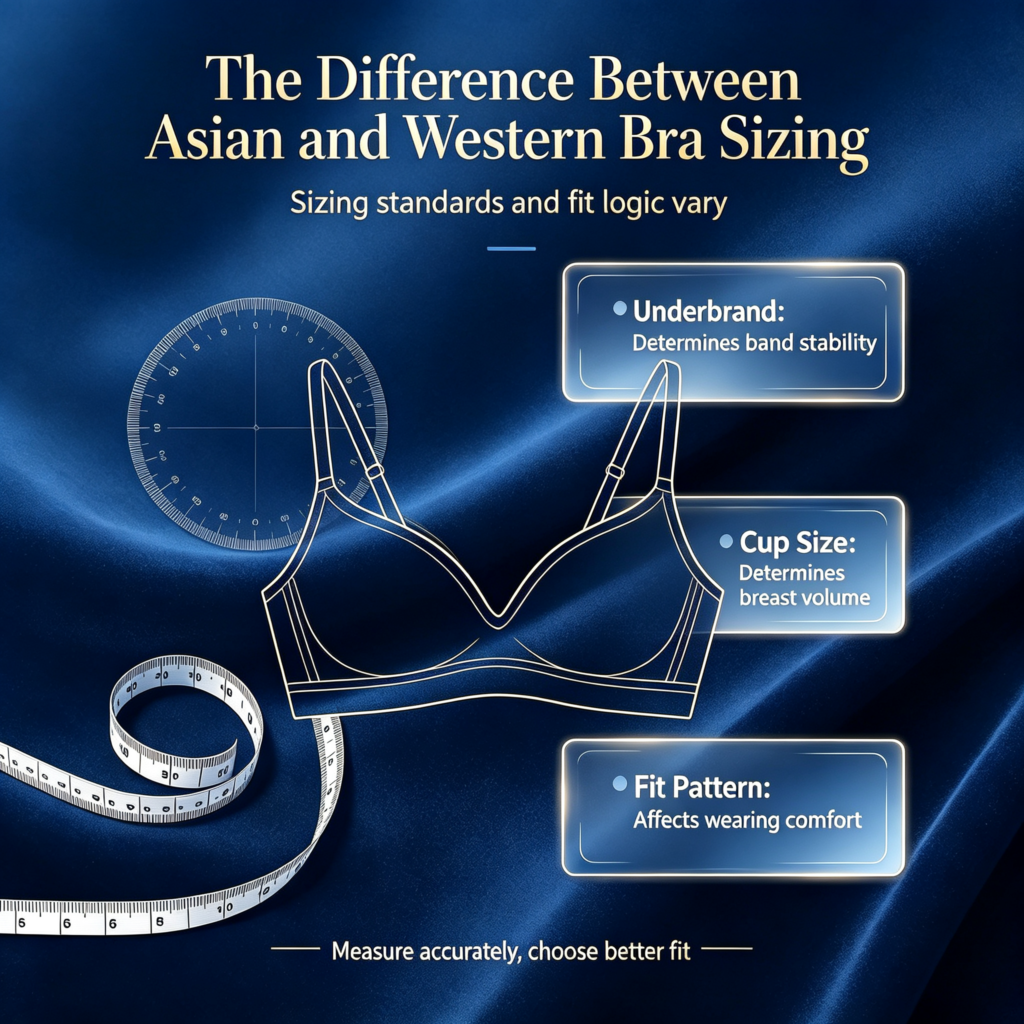
1. The Difference Between Asian and Western Bra Sizing
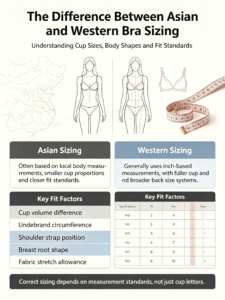
1.1 Measurement Baselines
The underbust measurement is the starting point for any bra size but the number that is used to determine the “band size” will differ in different parts of the world. Many Western systems, especially in the US, historically added a fixed number of inches to the actual underbust measurement before assigning a band size.
Most Asian sizing systems, on the other hand, use the underbust size in centimeters and accept no or minimal amount of allowances. This one difference in the baseline calculation means that the band number is already determined before the size of the cup comes into play, and there is no reason why the same body should not result in two quite different band numbers with the two systems.
1.2 Cup Grading Increments
Even when band sizes are accounted for, cup letters don’t always represent the same volume. Cup size is calculated from the difference between bust and underbust measurement, but the size of the “step” between each letter — how many centimeters or inches separate an A from a B, or a B from a C — differs between systems.
Some systems increase by small volumes of space, so more letters are required to cover the same range; others increase by larger volumes of space. A “C cup” in one country may accommodate more or fewer cups than a “C cup” in another country, despite the same lettering.
1.3 Japan’s JIS Standard
Japan has its own official sizing system, called JIS, which is measured in 5cm bands instead of other common sizing systems. Although Japanese cup lettering is based on the same alphabet as US and UK letters, it does not necessarily have the same logic, as determined by this banding system. The Japanese band system is used and size conversion must use the entire band/cup system, not just the letter.
1.4 Korean Sizing Conventions
Korean sizing also starts from underbust measurement but tends to use finer size increments than some Western systems, allowing for more precise band options.
Korean brands often assume a narrower range of average band sizes in their standard offerings compared to Western brands, which can affect availability at the larger or smaller ends of the range. As with Japan, the cup lettering is calculated relative to Korea’s own banding logic, so direct letter comparisons across borders can be misleading without checking the underlying measurements.
1.5 Chinese Sizing’s Hybrid Influence
Chinese bra sizing doesn’t follow a single unified standard the way Japan’s JIS system does. Instead, it reflects influence from both Japanese and Western sizing conventions, layered with significant variation between individual domestic brands.
That is, two Chinese brands can have vastly different sizing systems and logic, as well as different international systems. Chinese sizing is not always the most reliable size standard for shoppers and requires greater trust than one national sizing standard.
1.6 Western” Sizing
The size system used in “Western sizing” may seem like a single system, but it is not. The US, UK, and most of continental Europe use different systems. The US and UK share similar underlying logic but diverge in cup lettering at certain sizes, so a UK size doesn’t always match its nearest US letter exactly.
Some European systems, especially those in France and Italy, have different conventions for the band numbering based on the underbust size measured in centimeters, which do not necessarily correspond to the band numbering of the UK and US based systems. To summarize, ‘Western’ is a convenient term and should not be interpreted as a strict sizing term.
1.7 Design Assumptions
Sizing systems aren’t just measurement formulas — they’re built around regional population averages, and that shapes far more than the printed number.
Average ribcage curvature and breast root width vary by region, as do average bust-to-underbust ratios, and manufacturers design wires, gores, and cup shapes based on the averages most relevant to their market. This doesn’t mean a properly sized bra from one area might not fit differently in another, as the bra itself isn’t built for that body type to begin with.
1.8 Conversion Charts
Simple letter-to-letter conversion charts are a common starting point, but they leave out volume and baseline differences that actually determine fit. A more reliable approach starts with measuring underbust and bust in centimeters, since that number is consistent regardless of labeling system.
From there, cross-referencing brand-specific size charts — rather than general regional conversion tables — accounts for both the sizing system and the individual brand’s own variations, which compound on top of each other in international shopping.
2. Conclusion
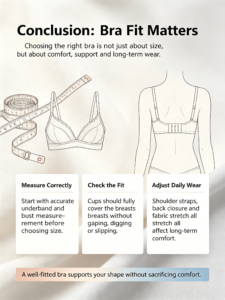
Asian and Western bra sizing differ in measurement baseline, cup grading, and the body-shape assumptions built into design — not just in labeling convention. The first step is to understand the differences so that you don’t become frustrated while shopping across regions.
3. Buy Asian & Western Bras for Telige
If international size charts have left you more confused than informed, it’s time to measure once and shop with confidence everywhere. Telige designs with these regional differences in mind, so you’re not stuck guessing whether a “C” really means the same thing across borders.
Use Telige’s sizing guide to convert your measurements accurately and find styles built around real body data, not just a converted letter. Fit that actually holds up starts with understanding the system — and Telige makes that translation simple.