
1. OEM Lingerie Manufacturing Explained
The global lingerie market has become more competitive. It’s the survival of the fittest, so brands make an effort to go out of their way in order to try to out-compete. They’re concerned more with comfort, style, and quality. As such, if you’re looking to launch a new line of lingerie or are looking to add an existing line, consider either Original Design Manufacturing (ODM) or Original Equipment Manufacturing (OEM).
Both manufacturing models are applicable to outsourcing, though the ownership of the design, product development, investment, production time, and customization is significantly different. Choosing the right approach can impact the quality of the product and determine future product development.
This guide looks at the key distinctions between ODM and OEM in the lingerie industry. It will also focus on the things to consider before choosing the manufacturing model.
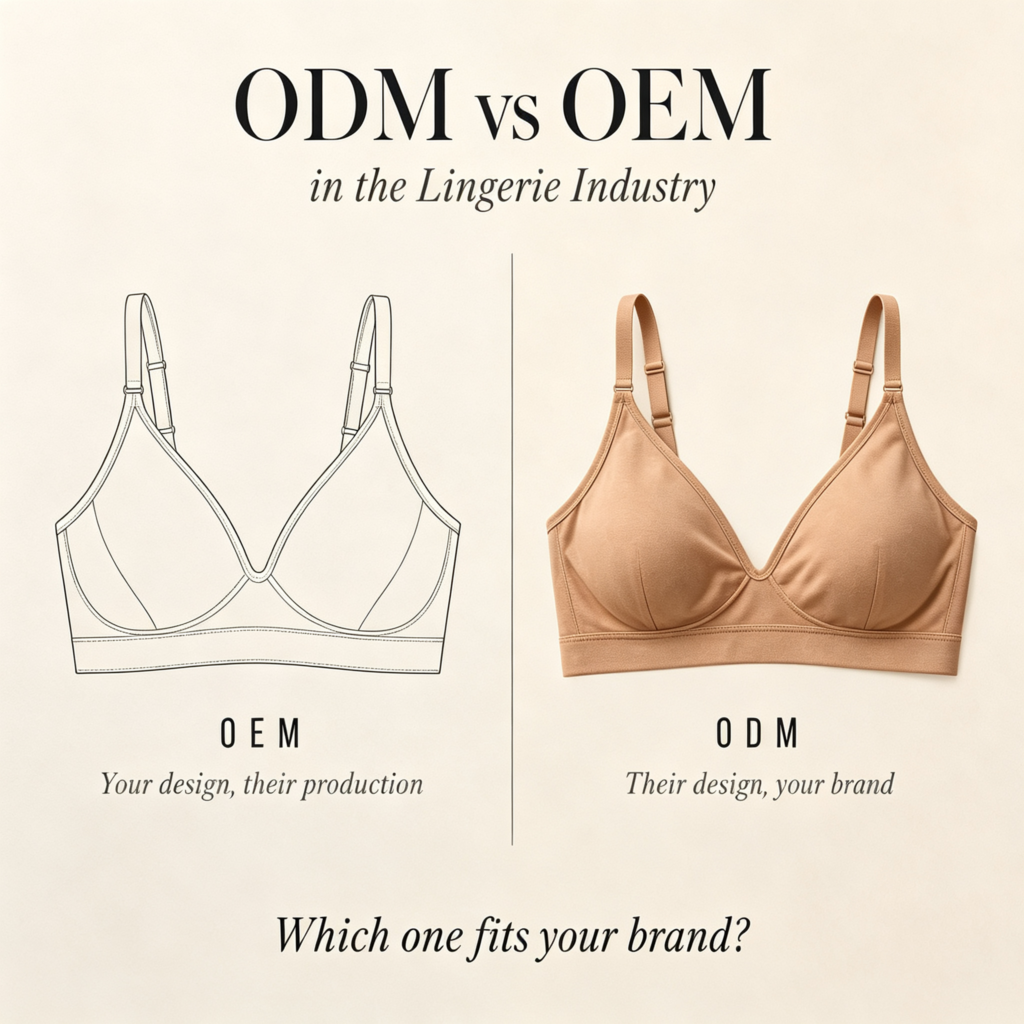
In the OEM (Original Equipment Manufacturing) concept, the lingerie brand designs its products, and the factory is responsible for producing them as per the brand’s requirements.
Typically, the brand will provide technical packs, measurement charts, fabric needs, build information, color standards, and packaging information. The manufacturer then converts these specifications into the finished products, all of which must adhere to certain quality standards.
OEM manufacturing allows for full freedom of design. All details like lace patterns, construction of cups, trims, elastics, and branding can be tailored according to the company’s vision. This is a method that many reputable brands of lingerie employ if they wish to have their own special lines and full control over the product.
2. What Do You Mean by ODM Lingerie Manufacturing?
Original Design Manufacturing (ODM) enables the factory to deliver pre-designed lingerie designs that brands can customize with their own brand.
The existing catalogs for such products are selected by businesses rather than the product being designed from scratch. They typically have the freedom to change the color, fabric, label, logo, packaging, and, to some extent, the design of the product without altering the basic product configuration.
Since the research, design, and pattern work have already been done, ODM enables branding to introduce products in a much faster time. It is especially well-suited for startups, online retailers, and companies starting to venture into the lingerie sector with minimal resources.
3. What’s the difference between ODM & OEM?
Both the manufacturing models utilize outside manufacturing. They are used for different business requirements. It is important to be aware of the following differences and make informed decisions accordingly.
3.1 Product Design Ownership
The main distinction is the ownership of the products. OEM manufacturing means the brand has the product concept and that the product is detailed out by the brand. The manufacturer only makes garments based on the specifications provided.
The manufacturing of ODMs is the reverse model. The factory has the original design and provides it to several customers. The buyer tailors some components into a new product but does not develop a complete product. Brands that want to make collections are usually more likely to go with OEM, as it helps to preserve the originality and boosts brand identity.
3.2 Level of Product Customization
It’s possible to customize the OEM to your requirements. It gives brands the option to choose components ranging from fabrics to underwires. They may also choose the lace, the foam, and the stitching techniques to use. Other considerations include the hardware, labels, and packaging. The construction of the garment can even be changed to satisfy specific performance requirements.
The factory has existing product designs, and fewer customization opportunities are provided by ODM. Most manufacturers will allow modifications to the colors, prints, branding, and packaging without altering the structure of the garment. For companies that need highly differentiated products, OEM manufacturing is definitely more beneficial.
3.3 Product Development Time
The manufacturing model should be in line with the overall brand strategy. Consider exclusive designs, using quality materials, and unique techniques that make luxury lingerie brands stand out from the rest. OEM manufacturing could be one of the options to consider. It gives flexibility in creating products.
Brands that prioritize affordability and fashion should leverage ODM to achieve faster product launch. ODM reduces development costs. Choosing a manufacturing model that aligns with your brand ensures consistency, making it stand out.
3.4 Select a Manufacturer that has the Proper Capabilities
In any case, the most critical decision is the choice of manufacturing partner – whether OEM or ODM. A competent lingerie maker must possess a high level of technological skills. They must be effective in communication and have a competent quality assurance team. It enhances the factory’s sampling ability and production capacity.
Besides, it enhances the raw material sourcing network and improves finished product delivery to international brands. To get the best, order samples, check out past work, and talk about the quality assurance process before production orders are placed. A dependable manufacturing partner can minimize manufacturing risks and aid with long-term business development.
4. The pros and cons of ODM and OEM in the manufacture of lingerie
When it comes to choosing a model, lingerie brands should decide whether to use Original Design Manufacturing (ODM) or Original Equipment Manufacturing (OEM). Each model has unique pros and cons, depending on the business objectives and brand strategy.
4.1 Original Design Bra Manufacturing (ODM)
As far as ODM is concerned, the supplier is responsible for designing and developing the lingerie. So the buyer sells them under their own brand name.
Pros of ODM
- Fastest product development due to ready designs
- Reduced Research and Development expenses
- Launching the product is fast
- Ideal for startups and small businesses
- Manufacturers are also familiar with the current trends in the lingerie industry and the needs of the market.
Cons of ODM
- Not quite as much customization as OEM.
- It can have similar designs sold to several brands, which can diminish uniqueness.
- Decreased control of product design and innovation
- More of a challenge to establish a solid brand identity
- Reliance on the manufacturer’s design skills
- OEM (Original Equipment Manufacturing)
4.2 Original Equipment Lingerie Manufacturing
In OEM production, the customer gives the product design, specifications, requirements, etc., and the manufacturer produces the product following the requirements.
Pros of OEM
- Complete product design, material, and feature control
- More flexibility to design special and unique lingerie designs
- Greater brand distinction and brand positioning
- Enhanced protection of brand name and intellectual property
- Options for customization in sizing, fabrics, trims, and packaging
Cons of OEM
- Increased development and design expenses
- Production lead time is increased due to design and sampling
- Requires technical knowledge and involvement of the buyer
- Minimum order quantities may apply for higher orders
- Higher risk if the product design is not in line with the market demand
ODM is a perfect match for companies looking to quickly and efficiently launch themselves into the lingerie market. At the same time, OEM is better for companies that want a product that’s unique and have greater control over the design and quality. This is based on the budget, timeframe, customization requirements, and branding goals.
5. Conclusion
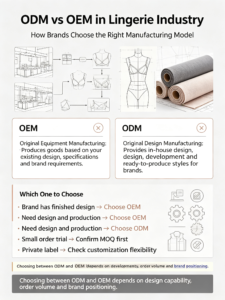
OEM and ODM are both critical parts of today’s lingerie business, but they have different business specialties. OEM provides maximum design freedom, superior intellectual property protection, and more opportunities for product differentiation. Best for brands looking for exclusive collections and long-term brand development.
ODM is dedicated to efficiency, cost-effectiveness, and market timeliness. It lets companies introduce products into the market rapidly, effectively, and at the same time gives some customization to enable them to have a successful launch. This is a great way that allows new brands to explore unique product categories.
The optimal manufacturing model will depend on your business goals and budget. Also, customization and long-term strategy matter. It is important for brands to thoroughly consider their expansion strategy before deciding. When it comes to lingerie manufacturing, businesses have the flexibility to work with a professional manufacturer that not only offers OEM and ODM services but also provides them with the right solution to enhance their success.
6. Collaborate with Telige for OEM/ODM Lingerie making.
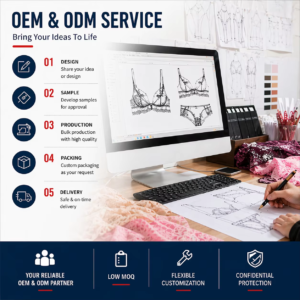
We offer professional OEM and ODM lingerie manufacturing services for brands globally at Telige. We have experts to help you create a unique design and make it your own. Telige provides you with reliable manufacturing solutions, such as sourcing materials and pattern development.
It also samples, engages in mass production, and quality control. The reason for doing all this is to help meet your business needs. Telige boasts sophisticated production capabilities, high standards of production, and customer responsiveness. It enables brands to confidently and efficiently launch quality lingerie collections.